- Call us : +91 96631 54960

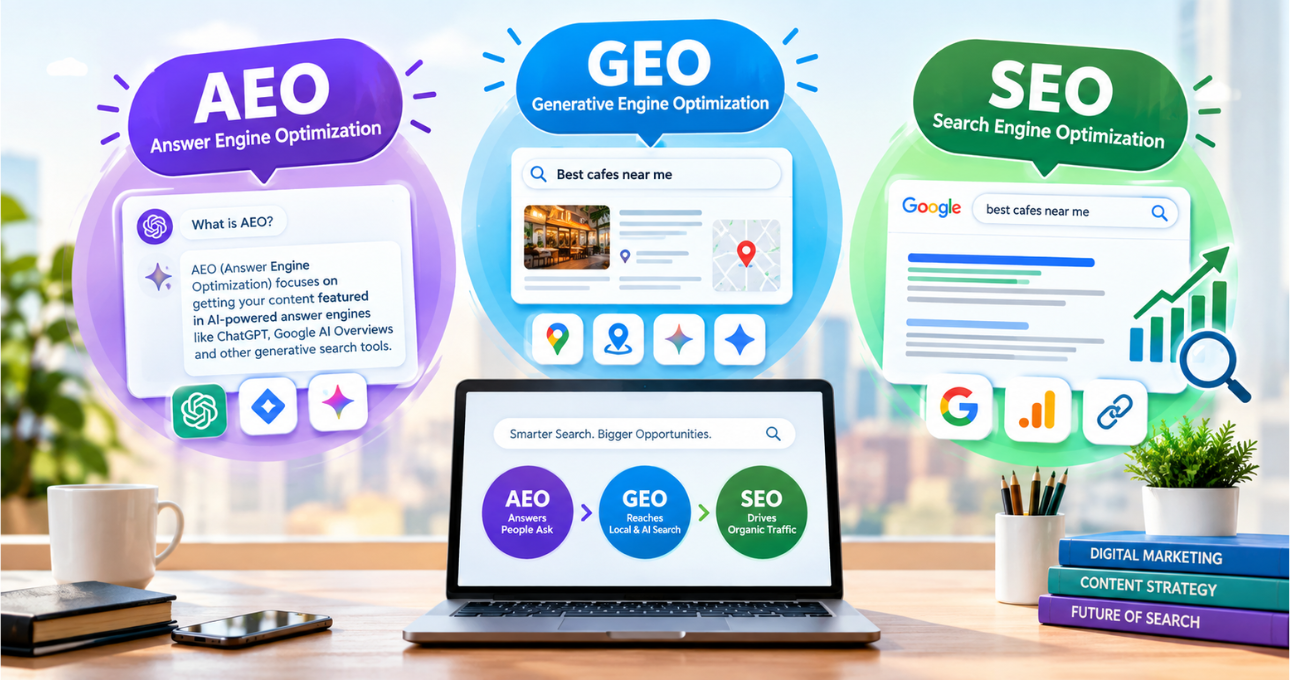

The way people search for information is changing. Earlier, a person would type a keyword into Google, open several websites, and compare the information. Today, users can ask a complete question and receive a direct response from a search engine or an AI platform.
This change has created new areas of digital marketing called Answer Engine Optimization (AEO) and Generative Engine Optimization (GEO). At the same time, traditional SEO continues to play an important role in helping websites appear in organic search.
This makes AEO vs GEO vs SEO an important topic for businesses that want to improve their online visibility. Although these three methods have similar goals, they approach search visibility in different ways.
Understanding their differences can help businesses create content that works for traditional search engines as well as newer AI-based search experiences.
SEO stands for Search Engine Optimization. It involves improving a website so that search engines can understand its pages and show them for relevant searches.
For example, imagine a user searches for:
"Best digital marketing services for small businesses in Bangalore."
A business offering digital marketing services may create a detailed page explaining its services, target customers, process, pricing factors, and experience.
Traditional SEO can involve several activities, such as:
The basic purpose of SEO is to make a website easier to discover through organic search.
AEO means Answer Engine Optimization.
The main idea behind AEO is simple: create content that gives users clear answers to the questions they are asking.
Consider a question such as:
"What is performance marketing?"
Instead of making the reader search through a long article to find the answer, an AEO-focused page can explain the meaning in the opening section and then provide examples and additional details.
AEO content can include:
The key difference between AEO and SEO is how the content is presented for search.
Traditional SEO is often concerned with helping a page gain visibility and attract visitors from search results.
AEO places more attention on making individual answers easy to understand and identify.
For example, an SEO article may target the topic "digital marketing." An AEO-focused section within that article might directly answer "What does a digital marketing agency do?"
Both approaches can exist on the same page.
GEO stands for Generative Engine Optimization.
GEO has become important because AI-powered search systems can generate responses instead of simply showing a list of web pages.
A user might ask an AI search system:
"How can a small business increase leads through digital marketing?"
The system may create a response by combining information from different sources.
GEO focuses on creating useful, trustworthy, well-organized information that generative systems can understand and potentially use when producing these responses.
Important elements can include:
The GEO vs SEO difference becomes clearer when we look at their primary search environments.
SEO is traditionally connected with organic search results and website traffic.
GEO is concerned with the growing role of generative systems that summarize information and answer users in a conversational format.
For instance, SEO may help a business page become visible when someone searches for a service.
GEO focuses on making the information on that business's website useful and understandable in an environment where AI systems may generate an answer instead of simply displaying ten blue links.
AEO and GEO are related, but they are not identical.
AEO is centered around answering questions.
GEO is centered around visibility and representation in generative AI experiences.
A simple example can help.
Suppose a company publishes an article called:
"How Much Does Digital Marketing Cost for a Small Business?"
An AEO approach would make the pricing question easy to answer with clear sections and explanations.
A GEO approach would also consider whether the entire article provides useful, reliable, well-organized information that a generative search system can understand when preparing a response.
Therefore, AEO can be considered more answer-focused, while GEO has a broader generative-search focus.
| Area | Traditional SEO | AEO | GEO |
|---|---|---|---|
| Main purpose | Improve organic search visibility | Provide direct answers | Improve visibility in generative search |
| Main focus | Websites and search results | Questions and answers | AI-generated responses |
| Content approach | Search intent and topical relevance | Direct, concise answers | Useful, authoritative information |
| Common content | Blogs, service pages, landing pages | FAQs, definitions, how-to answers | Detailed guides, expert content, original insights |
| User experience | User visits a webpage | User finds an answer | User receives an AI-generated response |
| Key opportunity | Organic traffic | Answer visibility | AI-driven discovery |
| Works with other methods? | Yes | Yes | Yes |
These approaches should not be viewed as completely separate systems. A single well-written article can support SEO, AEO, and GEO at the same time.
The comparison of traditional SEO vs AEO is mainly about content presentation and user intent.
Traditional SEO encourages marketers to understand what people search for and create useful pages around those topics.
AEO takes the next step by identifying the specific questions users may ask.
For example, instead of targeting only:
"Google Ads for small business"
a content strategy can also cover questions such as:
This gives readers quick answers while also creating a more complete resource.
When comparing traditional SEO vs GEO, the biggest change is the way information may reach the user.
With traditional search, the user commonly sees search results and chooses a website.
With generative search, the user may receive a written response that brings together information from several sources.
Because of this, businesses should focus on creating content that explains subjects properly instead of producing pages only to place keywords repeatedly.
Content should provide genuine value through:
Search is no longer limited to one format.
A person may use Google for one question, an AI assistant for another, and a conversational search tool for a more detailed request.
This has created a broader concept known as AI search optimization .
Instead of preparing content for only one type of search, businesses can build content that is useful across different discovery platforms.
A strong approach can include:
1. Start With Real Questions
Think about the questions customers ask before, during, and after purchasing a product or service.
2. Answer Quickly
Give a short answer first. Follow it with additional information for readers who want more detail.
3. Explain the Topic Completely
Do not create thin pages that answer only one small part of a topic. Cover related questions where they genuinely help the reader.
4. Use Clear Organization
Headings, lists, tables, examples, and short paragraphs make information easier to navigate.
5. Add Original Value
Personal experience, expert opinions, case studies, original examples, and useful data can make content more valuable than generic information available everywhere.
6. Keep Information Updated
Business information, pricing, technology, and search behavior can change. Regular updates help keep important pages useful.
Businesses in Bangalore are also exploring new search strategies as customers increasingly use digital platforms to research services.
Companies looking for AEO services Bangalore may need help with question-based content, FAQs, website structure, and content that provides direct answers to customer queries.
Businesses exploring GEO services Bangalore may focus on improving their online information for generative search environments. This can involve creating detailed content, strengthening topical authority, publishing useful insights, and maintaining consistent business information across digital platforms.
For local businesses, these strategies can be combined with local SEO, Google Business Profile optimization, location pages, reviews, and useful service content.
A business does not necessarily need three completely different content strategies.
One strong article can serve multiple purposes.
For example, a blog about "Digital Marketing for Restaurants" can:
This creates a more complete content strategy.
A strong website foundation is still important.
Before focusing heavily on new search trends, businesses should make sure their website has useful content, clear navigation, good technical performance, accurate information, and pages that genuinely help customers.
Once that foundation is in place, businesses can improve their content with question-based sections and information designed for modern search experiences.
This approach avoids creating separate content for every new search platform.
The difference between AEO vs GEO vs SEO is mainly connected to how people discover and consume information.
Traditional SEO focuses on organic search visibility and helping people find relevant web pages. AEO focuses on answering specific questions clearly and directly. GEO focuses on the growing world of generative search, where AI systems can combine information and create conversational responses.
These methods are not necessarily competitors. They can work together as part of a broader digital marketing strategy.
1. What is AEO vs GEO vs SEO?
SEO focuses mainly on organic search visibility. AEO focuses on providing direct answers to user questions, while GEO focuses on improving visibility and representation within generative AI search experiences.
2. Is AEO different from SEO?
Yes. AEO has a stronger focus on answering specific questions directly. SEO has a broader focus that includes search visibility, website structure, technical performance, content, links, and search intent.
3. Is GEO replacing SEO?
GEO does not mean that traditional SEO has become unnecessary. Businesses can use SEO as a foundation while also preparing their content for AI-powered search experiences.
4. What is the main difference between AEO and GEO?
AEO is primarily focused on answer-based search. GEO focuses on how information can be understood and represented in generative AI experiences. There is some overlap between the two.

Leave a Comment
Your email address will not be published. Required fields are marked *