
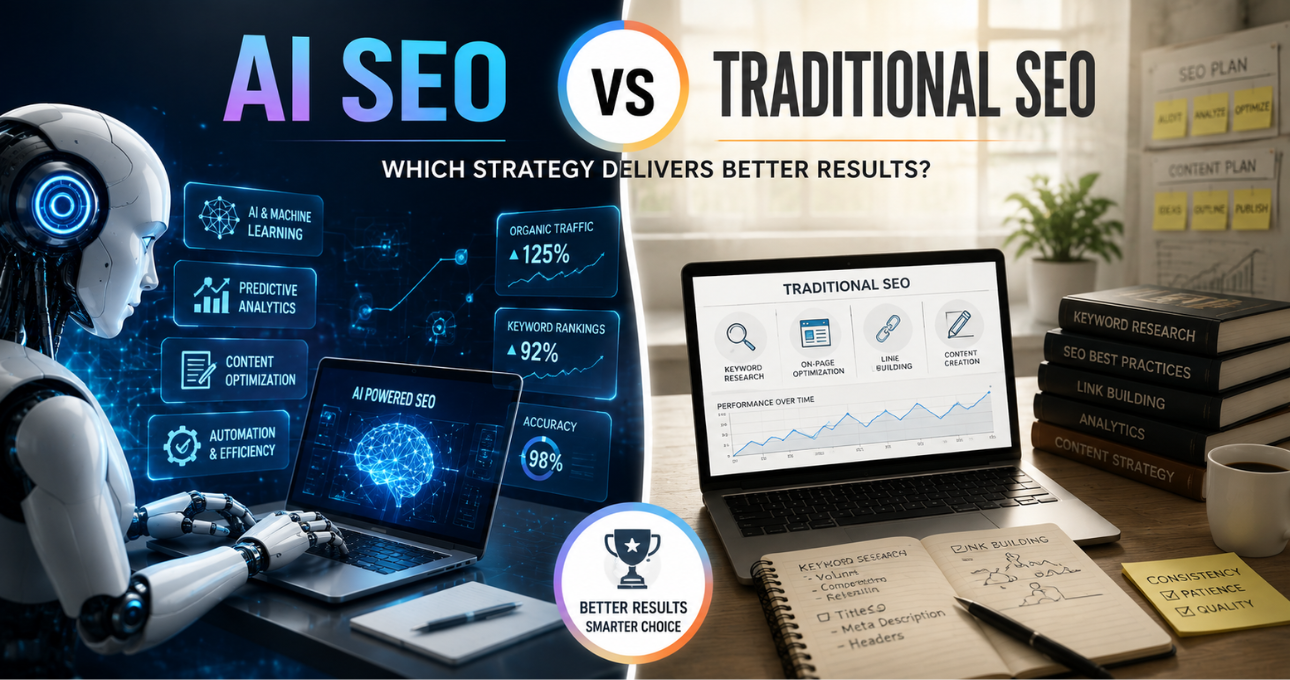
AI SEO vs Traditional SEO: Which Strategy Delivers Better Results?
Introduction
Search is changing faster than ever. People no longer search only by typing short keywords into Google. They now ask detailed questions, use AI tools, and expect direct answers. This change has created a new approach to search marketing called AI SEO.
For businesses, especially those competing in a busy market like Bangalore, understanding this shift is important. AI SEO services in Bangalore can help businesses prepare their websites for both traditional search engines and AI-powered search platforms.
But does AI SEO replace traditional SEO? Not really. Traditional SEO still plays a major role in helping websites rank, attract visitors, and build trust. At the same time, AI SEO focuses on making content easier for AI systems to understand, process, and use in search answers.
So, which strategy delivers better results? The answer depends on your business goals. In most cases, combining traditional SEO with AI-focused optimization can create a stronger long-term strategy.
What Is Traditional SEO?
Traditional SEO is the process of improving a website to rank higher in search engine results. It focuses on areas such as:
- Keyword research
- Website structure
- On-page SEO
- Technical SEO
- Backlinks
- Meta titles and descriptions
- Content optimization
- Website speed
- Mobile usability
For example, a business selling digital marketing services may target keywords such as "digital marketing agency in Bangalore." The website content, headings, pages, and backlinks are then optimized around relevant search terms.
Traditional SEO works well because search engines still use many of these signals to understand websites and decide how they should appear in search results.
What Is AI SEO?
AI SEO is an approach that focuses on optimizing websites and content for modern search experiences powered by artificial intelligence.
AI search tools can understand the meaning behind a question instead of simply matching exact keywords. Because of this, content needs to provide clear, useful, and complete answers.
AI SEO services in Bangalore can include content optimization, entity building, structured information, question-based content, and strategies designed to improve visibility across AI-powered search experiences.
AI SEO often works closely with concepts such as generative engine optimization, AEO, and GEO.
Understanding Generative Engine Optimization
Generative engine optimization focuses on improving content so that generative AI platforms can understand and potentially reference it when creating answers.
Instead of focusing only on ranking a webpage at position one, the goal is to make the brand and its information useful enough to appear within AI-generated responses.
What Are AEO and GEO?
AEO, or Answer Engine Optimization, focuses on creating content that directly answers user questions.
GEO, or Generative Engine Optimization, focuses more specifically on visibility within generative AI search experiences.
Both approaches encourage businesses to create content that is clear, trustworthy, well-structured, and easy for machines and people to understand.
AI SEO vs Traditional SEO: Key Differences
While both strategies aim to improve online visibility, their approaches differ.
| SEO Factor | Traditional SEO | AI SEO |
|---|---|---|
| Main Focus | Search engine rankings | Search engines and AI search |
| Keyword Approach | Exact and related keywords | Topics, intent, entities, and meaning |
| Content Style | Keyword-focused useful content | Answer-focused and context-rich content |
| User Search | Mainly typed searches | Typed, conversational, and AI-based searches |
| Main Goal | Higher rankings and organic traffic | Visibility, answers, mentions, and traffic |
| Important Concepts | Backlinks, technical SEO, keywords | GEO, AEO, semantic SEO, AI search |
| Content Structure | Optimized articles and landing pages | Clear answers, context, facts, and structured content |
Why Traditional SEO Still Matters
The growth of AI search does not mean traditional SEO is outdated.
Search engines still depend on website quality, technical performance, useful content, authority, and relevance. A poorly optimized website may struggle to perform well even if its content is written for AI systems.
Traditional SEO also helps businesses build a strong website foundation. Good page speed, mobile usability, internal linking, clean URLs, and quality backlinks remain valuable.
Therefore, businesses should not completely abandon traditional SEO. Instead, they should improve it to meet the changing search environment.
Why AI SEO Is Becoming Important
Search behavior is becoming more conversational. Instead of searching "best SEO agency Bangalore," a user may ask an AI tool, "Which SEO agency in Bangalore is suitable for a small business?"
This type of search requires content that understands the complete question and provides a useful answer.
This is where AI search optimization becomes important. Businesses need content that answers real questions, explains topics clearly, and demonstrates knowledge in their industry.
Another important area is semantic SEO. Instead of focusing on one keyword repeatedly, semantic SEO helps search engines understand the wider topic and relationship between different concepts.
How Semantic SEO Supports AI Search
For example, an article about SEO services may naturally discuss technical SEO, keyword research, content marketing, local SEO, backlinks, search intent, and AI search. This gives search systems stronger context about the topic.
Building topical relevance helps a website communicate expertise more clearly and creates useful connections between related subjects.
Which Strategy Delivers Better Results?
There is no single winner between AI SEO and traditional SEO.
Traditional SEO is highly useful for building organic rankings and website authority. AI SEO helps businesses adapt to new search behavior and AI-powered platforms.
The strongest strategy is to combine both.
A business can first use traditional SEO to build a technically strong website. Then, it can improve its content using AI-focused methods. This can include answering common customer questions, creating topic-based content, using structured information, strengthening brand authority, and providing accurate facts.
Businesses looking for AI SEO services in Bangalore should therefore look for an approach that does not treat AI SEO and traditional SEO as completely separate strategies.
How Businesses Can Prepare for the Future of Search
Businesses can take several simple steps to improve their search visibility.
1. Create Helpful Content
Write for people first. Answer questions clearly and avoid unnecessary filler.
2. Cover Topics in Depth
Instead of creating many short articles around similar keywords, build useful content that covers a complete topic.
3. Answer Customer Questions
Add FAQs and question-based sections to important pages. This can help users find quick answers.
4. Build Brand Authority
Use accurate information, expert insights, reliable sources, and consistent brand information across the web.
5. Improve Technical SEO
Make sure pages load quickly, work well on mobile devices, and can be easily crawled by search engines.
6. Use AI Carefully
AI tools can help with research, content ideas, and optimization. However, every piece of content should be checked for accuracy, originality, and usefulness.
The Future of SEO Is a Combination
The future of SEO is not about choosing between humans, search engines, or AI. It is about creating content that works for all three.
A strong SEO strategy should attract users through traditional search, answer their questions directly, and provide information that AI systems can understand.
This makes AI SEO services in Bangalore increasingly useful for businesses that want to stay competitive as search continues to evolve.
Companies that start adapting now can build a stronger foundation before AI-powered search becomes an even bigger part of the customer journey.
Conclusion
AI SEO and traditional SEO are not competitors. They are two parts of the modern search strategy.
Traditional SEO provides the foundation through technical optimization, keywords, content, links, and website authority. AI SEO adds another layer by focusing on user intent, conversational searches, structured answers, semantic relationships, and AI-powered search experiences.
For most businesses, the best approach is to combine both. By using traditional SEO while adopting AI SEO techniques, businesses can improve their chances of reaching users through different types of search.
If you want your business to stay visible as search evolves, investing in AI SEO services in Bangalore along with a strong traditional SEO strategy can be a smart long-term move.
Frequently Asked Questions
1. What is AI SEO?
AI SEO is the process of optimizing website content and online information for modern search systems, including AI-powered search platforms. It focuses on user intent, context, clear answers, entities, and useful content.
2. Is traditional SEO still important in 2026?
Yes. Traditional SEO remains important because technical SEO, website quality, relevant content, authority, and user experience continue to influence organic search visibility.
3. What is the difference between AEO and GEO?
AEO stands for Answer Engine Optimization and focuses on providing direct answers to user questions. GEO, or Generative Engine Optimization, focuses on improving visibility within generative AI search experiences.
4. How does semantic SEO help with AI search?
Semantic SEO helps search systems understand the meaning and relationship between different topics, terms, and entities. It allows content to provide wider context instead of relying only on exact keyword matches.
5. Should businesses invest in AI SEO services?
Businesses that want to prepare for changing search behavior can benefit from AI SEO. The best approach is to combine AI search optimization with traditional SEO instead of replacing one with the other.

Leave a Comment
Your email address will not be published. Required fields are marked *